Stuck in a Running Plateau? Why Your Training Follows a Mathematical Formula
If you’ve recently taken up running, you probably expected your fitness to look like a straight line pointing up. In reality, running progress follows a biological model of growth known as the Sigmoid Curve. Understanding this curve can save you from premature burnout or throwing your running shoes in the closet out of frustration.
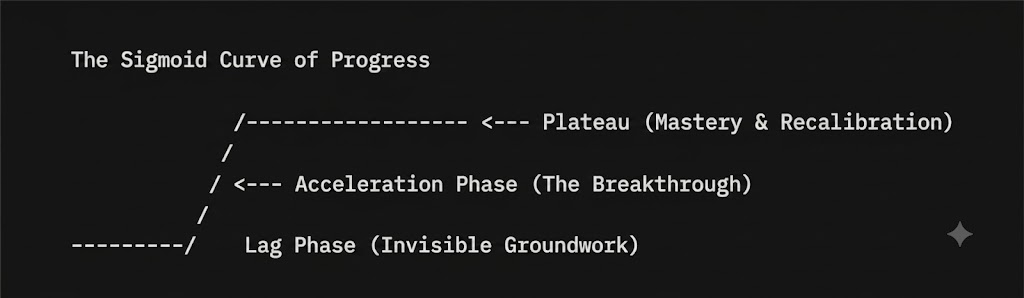
As outlined in Endure to Rise, every training block cycles through three distinct phases:
- The Lag Phase (Weeks 1–4): Progress feels non-existent. Your lungs burn, your muscles ache, and you might actually feel worse than on day one. But beneath the surface, invisible transformations are happening: your mitochondria are multiplying, and your capillaries are expanding to deliver more oxygen. Tip: Run SLOW during this phase to minimize painful stimuli!
- The Acceleration Phase: The breakthrough. Suddenly, your breathing steadies, your paces drop dramatically, and distances that felt impossible feel within reach. This is the reward for consistency.
- The Plateau: Progress levels off. This isn’t a sign of failure; it means your body has fully adapted to your current workload. Elite coaches call this the cue for progressive overload; it’s your invitation to safely change up your volume or intensity to spark the next curve.
Patience is the ultimate currency in distance running. Trust the curve